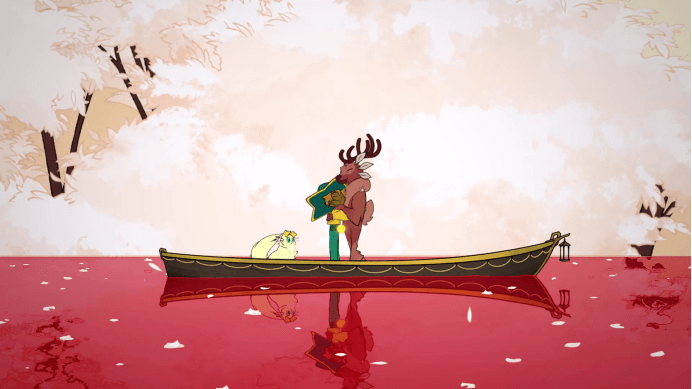


When I stroked the luminous silk threads in the air with my fingers for the first time, they trembled like alarmed strings. Each line is a possibility of the future, staggered in front of my eyes, some are as bright as noon, and some are as gloomy as the fire that is about to be extinguished. My name is Allegra. I have the ability to shuttle between the real city Bras and the spiritual world Reverie. At this moment, I am standing at the intersection of the two worlds. What I hold in my hand is no longer a tool, but the fate of countless people. _Harmony: The Fall of Reverie_ made me understand that choice is never a one-way fork in the road, but a net that needs to be woven by hand.
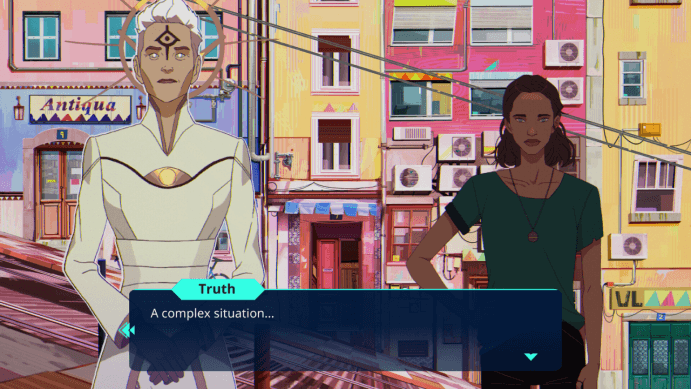
The reality is a science and technology city in the near future, which is clean and efficient but lacks emotions; the fantasy dreamland is the spiritual world composed of consciousness, guarded by six “aspirations” who incarnate human emotions — joy, anger, fear, faith, struggle and love. Every time I shuttle, I leave ripples in the two worlds. In Bras, I investigate the conspiracy of a company that tries to control the emotions of all human beings; in the dreamland, I listen to the worries of spirits about the loss of human emotions. But the core of the game is not the battle, but the “line of fate system” — all key choices are visualized in colored silk lines, and I must decide which line to weave into the atlas of fate.
The process of weaving is full of weight. When the spirit of “fighting” suggested that I expose the conspiracy of the enterprise to cause turmoil, the golden silk thread began to shine; when the spirit of “belief” advocated finding a way to internal reform, the silver silk thread trembled gently. I can’t catch all the lines at the same time. Every time I choose one, the other lines will be dim or even disappear. The most difficult thing is those seemingly irrelevant daily choices: comforting a crying stranger will strengthen the silk thread of “love”, but it may make me miss the key meeting with the corporate informant. The game does not evaluate right and wrong, but only faithfully turns each choice into a part of the pattern — sometimes close and harmonious tapestry, sometimes full of contradictory knots.
Spirits are not symbols, but living characters. Anger is a burning teenager, his advice is radical but passionate; fear is a little girl wrapped in a cloak, her warnings are often cruel and true. As the weaving deepened, I found that they each had a secret connection with the characters in reality: the barista who was always smiling was the anchor of “joy”, while the radical social activist was attached to “strike”. I gradually realized that what I weave was not only abstract fate, but also the joys and sorrows of these concrete lives.
The most exquisite moment of the game takes place at the resonant point. When the contradiction between reality and the spiritual world intensified to the peak, I had to sit in front of the huge fate loom and weave the final pattern with the silk thread formed by all the previous choices. At this time, the perspective will be widened. I can see how my lifeline is intertwined with others and how it affects the context of the whole society. Once, in order to stop the control plan of the enterprise, I chose the red silk thread of “fighting”. As a result, the mother’s blue silk thread (representing “belief”) in the picture suddenly broke — she was arrested for protesting in another timeline. The game did not pause and made me regret it, leaving only a permanent void on the brocade, like a silent sigh.
As the chapter progressed, I learned to read the texture of silk thread. Rough lines represent difficult but profound changes, and smooth lines point to a stable but potentially shallow future. Some lines will suddenly fork, suggesting the possibility of hiding; some lines will be dead knotted, which is an irreparable regret. Weaving is no longer a mechanism. It has become my language of view of the world — I began to understand how each decision casts ripples on the fabric of time.
The ending is not a single victory. When I finished the final knitting, the brocade was suspended between reality and the spiritual world. There were bright parts and shadows on it, complete patterns and broken threads. The spirits stood quietly on both sides of the brocade, and the friends in reality looked up at the map of our common destiny. No one cheered, because everyone knew that perfect harmony did not exist. The real balance was to accept every light and shadow on the tapestry, and still choose to cherish this imperfect but real pattern.
After exiting the game, I looked at the city lights outside the window. For the first time, I felt that there was an invisible silk thread trembling gently under each lamp. _Harmony: The Fall of Reverie_ did not give me a simple answer to save the world. It gave me a loom to imagine fate. It made me understand that each of us is a weaver, and every little kindness, every brave persistence, and even every last resort compromise is adding a stitch to the world’s huge brocade. The most profound harmony of life may not be to eliminate all chaotic lines, but to find the direction of your own thread in the chaos, and gently weave it into a larger picture.