

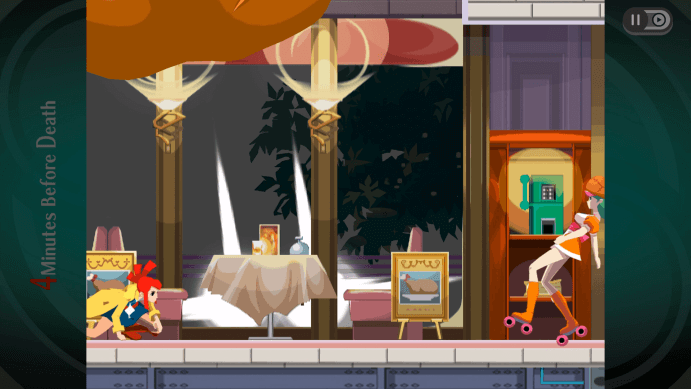
When the alarm clock pointed to two o’clock in the morning, I was dead. A bullet went through my chest, and then I floated up and saw my body lying next to the trash can — the suit was cheap and my identity was unknown. But death is not the end, because in the next second, I found myself attached to any object: street lamps, cans, and swivel chairs. And a mysterious voice sounded in my ear: “You have four minutes to change the fate of that girl before she was shot.” The opening of _Ghost Trick: Phantom Detective_ is like an absurd black comedy, and I, a ghost who doesn’t even know my name, became the only director.
The ability is ridiculously simple. I can make the telephone handset jump up and hit the switch, make the drawer suddenly bounce open to block the bullet, and make the chandelier shake to attract attention. But the rules are strict: only inanimate objects can be manipulated, and the perfect chain reaction must be found in a four-minute time cycle. The first task stuck me for half an hour — to save the girl by the window, I need to turn the fan to blow up the curtains first, then use the curtains to turn the switch on the wall, and finally let the fallen signboard block the killer’s sight. After each failure, time goes back, and my body next to the trash can always reminds me that you have nothing in the first place, except these four minutes.
As the rescue progressed, I pieced together the fragments of my memory. My name is Sissel, an ordinary piano tuner, but why did I appear at the dock on the night of my death? Lynn, the girl I saved, is an intern prosecutor. Why was she chased and killed? What’s more strange is that those objects possessed by me occasionally “remember” the past — a jukebox remembers the tune I played last night, and the bench on the street corner remembers that I sat there and waited for people. The world has become a huge memory puzzle, and every inconspicuous object may be a key fragment.
The best thing about the game is its physical logic. All the puzzles are based on the chain reaction of “if it’s like this... it will be like that...” To move the crane, you may need to let the pigeon fly to trigger the sensor first; to open the locked door, you may have to guide a cat to jump on the external unit of the air conditioner. There is no hint, only repeated trial and error, and every success is like completing an exquisite magic show. Although the picture is 2D, the interaction of objects is full of animated exaggeration and expressiveness, which makes every manipulation feel like a cartoon.
The characters live in their own plot. Inspector Cabanela, whose windbreaker is always flying, speaks like singing; the guard’s big mother, who always carries fried chicken, is a former agent in secret; even the dachshund who always wanders around has his own mind. I observed their conversation for four minutes and found that everyone was looking for the same person — and I gradually realized that that person might be me.
The truth was revealed on the last night. When all the timelines closed, I found that my death was not accidental, Lynn’s attack was not a coincidence, and even this ability to manipulate objects was part of a huge plan. The final puzzle requires me to manipulate twelve objects at the same time to complete the chain. When the organs on the screen are triggered like dominoes, I suddenly understand that the so-called ghost skills are never superpowers, but give those who have not connected to the world well in their lifetime a chance to reconnect everything.
At dawn, I found my name, my memory, and my sense of being alive. At the end of the game, there was no gorgeous animation. Only Lynn and I stood on the early morning dock, and the seagulls flew in the distance. I really touched the sunshine for the first time — through a finally complete body.
After quitting the game, I stared at the table lamp on the table for a long time. _Ghost Trick: Phantom Detective_ did not give me a deep philosophy. It gave me an absurd and warm ghost experience for a night. It whispers to me that the meaning of life may not lie in how much time you have, but in whose limited time you are willing to press the switch that makes the street lamp suddenly turn on. After all, sometimes you don’t need superpowers to save the world. All you need is a stubborn ghost’s heart that is willing to make the phone beacon jump for a stranger at two o’clock in the morning.