

The color of the potion stopped on an orange-red that was almost sunset, which was still a little short. I held the mouse, like holding a real glass stick, and slowly drew a circle in the crucible of _Potion Craft_. The liquid rotated, and the edge showed a little purple golden halo that I wanted. It’s almost there. I held my breath and slowed down to let the halo penetrate into the center without disturbing the stable red at the bottom. It’s done. The bottle of “courage potion” emits a warm light on the shelf, which is slightly different from my last bottle of slightly impatient finished products.
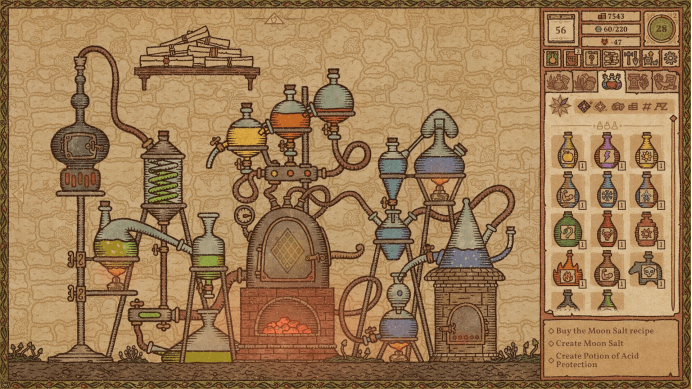
The system only determines the composition and effect, and it doesn’t care about the gloss. But I care. What I care about is the few seconds of holding back breathing, which is the small angle of the wrist hovering. This bottle of potion is different. It records my careful “stirring”.
We thought that the digital world was a pure instant transformation of ideas and results until I put down the first brick in _Townscaper._
There is no blueprint and no goal. Only the sea, and waiting to be defined blanks. I clicked, and a warm yellow square surfaced. Click again, and it will grow up and become a floor. My rhythm is the only rule. A quick and firm click will summon the adjacent towers and arcades, like a sentence that comes out of the mouth. And once hesitating, once after letting go of the mouse, the next square may be independent not far away, becoming a small watchtower facing the sunset.
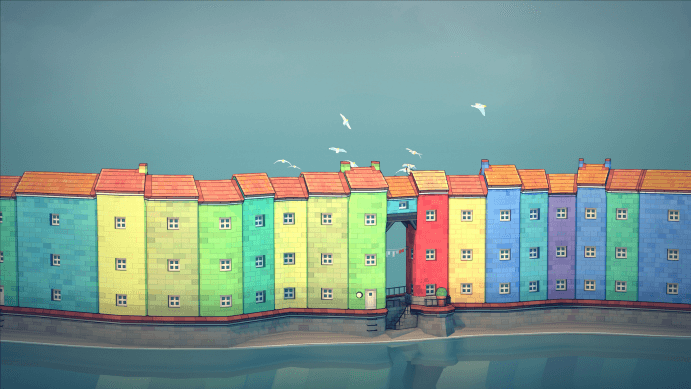
This is not construction, but listening. Listen to the vague melody about “town” in your heart, and then use clicks to translate it into bricks, stairs and occasional roof gardens. The spire that seemed too high because of the shaking of the hand once, the air corridor that was accidentally formed to connect the two houses — they are not wrong, but the fossils of my hesitation and spiritual light in the pixel world. It can’t be copied, because it can’t be copied the weather and heartbeat at the moment when I clicked it.
I turned off the game and looked at my hands. It hasn’t really “made” anything in the real world for a long time. We live in a world of results — perfect items, instant services, and communication is compressed into icons. The process was omitted as much as possible.
But why, in front of the virtual crucible, I hold my breath for an irrelevant luster? Why do I smile at an extra click on the virtual sea?
Perhaps the digital world has not taken away the desire of our hands. It’s just a change of material to settle this desire. It allows us to replace the carving knife with the trajectory of the mouse, replace the hammer with the rhythm of click, and replace the perception of temperature with the length of staring. It makes us still stubbornly pursue the trace of “this time” in a world that can be revoked and perfectly copied indefinitely — the bottle of shiny and unique potion, the small town that grew up from the state of mind at that time.
That is not the product of the code, but the warm fingerprints we leave on the virtual things through the code.