

My whole world is the square meter behind the counter.
The sun shines in obliquely, shining on the mountains of documents, and the dust slowly floats in the light column. Outside the window is a gray square, and several figures pass by in a hurry. My eyes must be taken back and fall on the worn-out passport in front of me. The man in the photo dodged his eyes, and the ink on the seal seemed to be fainted unnaturally. In _Papers, Please_, I am the small window, the filter called “checkpoint”. The vast country, the complex politics, and the displaced life are finally compressed into the entries that can be ticked or crossed in front of me.
At first, I just wanted to make no mistakes. Date, signature, steel seal. I’m like a rusty machine, checking, letting go, or refusing. The joys and sorrows outside the window have nothing to do with me. I’m just the executor of the rules.
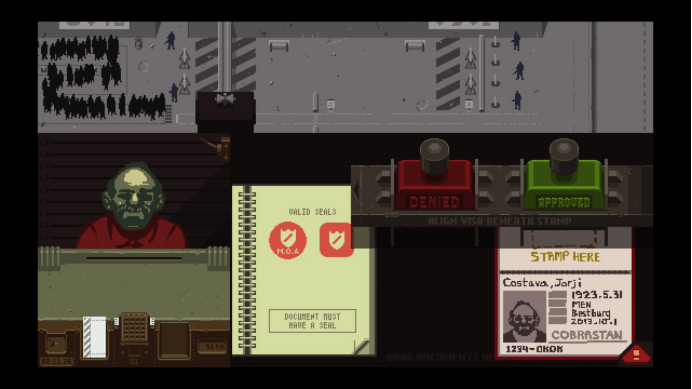
Until that day, a man came to my window for the third time. There were problems with his documents twice before, and I rejected him. This time, the documents are perfect. But just as I was about to stamp, he suddenly knocked a rhythm on the counter with his knuckles: Da, Da, Da. That was the tune of a nursery rhyme from my hometown that I accidentally tapped with my finger when he first came. He remembered it.
My hand stopped in mid-air. There is no clause about cipher in the rules. The perfect document is waiting silently. Outside the window, the twilight is sinking. I raised my head and really saw his face clearly for the first time, the face that had been repeatedly rubbed by anxiety and hope. Then, I stamped it. Not as a machine, but as a person, the identification of another person.
My world is still only one square meter, but its boundaries have collapsed silently in my heart.
Another window that made me stare for a long time was in _The Room_. It is not a window to the outside world, but a walnut-shell universe locked inside the strange device.
Throughout the game, what I faced was a mysterious box fixed on the table. I have no body, no movement, only a pair of hands and a magnifying glass-like line of sight that can move freely. I must observe the surface of this “world” and look for those almost invisible gaps, tiny sliders, and the luster that needs a specific angle to reflect the code. My vision is physically confined within the geometric range of the box, but my imagination is forced to go infinitely into the inside.
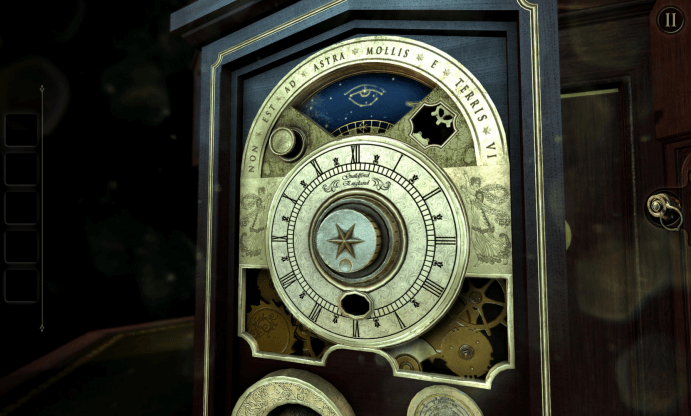
The small keyhole is not a passage, but a telescope to peek into the dimensional crack. When I approached and adjusted the focal length, it was not a mechanical structure, but a rotating starry sky or a miniature palace corridor. I turned the knob on the side of the box, and what came from inside was not the sound of gears, but the distant and ethereal bell ringing. This limited perspective forced me to use all the senses that were ignored in daily life: the touch imagined by the fingertips when the touchpad moved, the ear’s capture of subtle sounds, and the physiological reaction of keeping the face close to the screen, as if it was really staring at an abyss.
The window didn’t get bigger. It was my perception. It got into the gap and became extremely sharp.
Isn’t our life infinitely observed from a limited window? The screen of the mobile phone, the compartment of the office, the balcony of the home, or a lingering fixed perspective in the heart. We often feel anxious because of this limitation and are eager to break through.
But these games tell me that the restriction may not be a cage, but a profound focuser. When vision is restrained, hearing, intuition and imagination will be forced to star on stage. When we can’t look at the whole situation, we will bet all our emotions and thoughts on the only details, so as to see the textures that are bound to be ignored in a broad vision — such as the trembling handwriting on a document, such as the whole star contained in a keyhole.
The important thing is never how wide the world you see, but how you see the part you see. The real breadth lies not in the boundary of the field of vision, but in the depth of gaze. Even if all you have is a small, dusty window.